

Quick answer
A newer Clarksburg home still needs fall plumbing prep, just a different list than an older house. These new home fall plumbing tips cover the basics: take hoses off frost-free faucets, winterize lawn irrigation, test the sump pump, and check the water heater's relief valve. If you have indoor fire sprinklers, know when WSSC Water says the backflow valve is due for service.
"It's a new house, do I really need to do anything?"
Yes, though the list is different from an older home's. Much of Clarksburg was built in the last couple of decades, in neighborhoods like Clarksburg Town Center, Cabin Branch and Arora Hills. Newer homes usually have modern pipe, frost-free outdoor faucets and good insulation. What they also have is more equipment: sump pumps, lawn irrigation, fire sprinkler systems, and water heaters with expansion tanks. Each of those needs a little attention every year.
These are the fall items we'd focus on in a newer Clarksburg home.
1. Take the hoses off your frost-free faucets
Most newer homes have frost-free outdoor faucets, which shut off the water inside the warm wall instead of at the spigot. They work well, with one catch: if a hose is left connected, water stays trapped in the faucet and can freeze and split it inside the wall. You often don't know until spring, when you turn it on and water runs into the basement.
Disconnect every hose in the fall. If your home also has indoor shut-offs for the outdoor faucets, WSSC Water recommends closing them and draining the lines.
2. Winterize lawn irrigation and plan the backflow test
Many newer homes have in-ground lawn irrigation. Shut it off and drain or blow out the zones before the first freeze, following your installer's instructions.
The irrigation system connects to your drinking water through a backflow preventer. WSSC Water requires these assemblies to be field tested every year, with results reported at spring start-up, by a WSSC-licensed plumber who is a certified cross-connection technician. Make a note now so the spring test doesn't get missed.
3. Know your fire sprinkler backflow valve
Many newer homes have an indoor fire sprinkler system. Where it connects to your water supply there's a backflow valve, often near the water meter or behind an access panel on the first floor. WSSC Water has rules for these:
- Homes built from 2007 to 2009 were required to have a testable double check valve assembly. Homeowners can either have it tested by a licensed cross-connection technician, or replace it with a non-testable dual check valve.
- A non-testable dual check valve must be rebuilt or replaced every five years.
- Replacing the assembly is done by a certified WSSC Master Plumber, coordinated with a certified fire sprinkler contractor, who must confirm the system still meets its flow requirements. Proof of that coordination goes to WSSC Water's Cross-Connection Control Program.
- If you get a courtesy notice from WSSC about your backflow device, don't ignore it.
4. Test the sump pump before the wet season
Many Clarksburg homes have finished basements with a sump pit. A sump pump failure in a finished basement is expensive, so test it every fall: pour a bucket of water into the pit and watch it turn on, empty the pit and shut off.
Call for help if the pump hums without pumping, runs constantly, or trips its outlet. We've seen that last one here in Clarksburg, and it usually means the pump needs replacing. Also check outside that the discharge pipe isn't clogged with leaves or buried under fresh mulch.
5. Check the water heater, relief valve and expansion tank
Water heaters in newer homes often have an expansion tank, a small tank on the cold water line that absorbs pressure as water heats. Look for a wet relief valve pipe, water around the base, or rust on the expansion tank. A relief valve that drips can mean the valve is worn, or that pressure is building because the expansion tank has failed.
Set the temperature to 120°F, which the U.S. Department of Energy recommends for most homes. Builder-installed water heaters in homes built around the same time often reach the end of their life around the same time, so note the age on the label and start planning if yours is getting up there.
6. Townhome? Check where your pipes run
In townhomes, water lines sometimes run through garages or along outside walls above a garage. Keep the garage door closed in cold weather and add foam sleeves to any exposed pipe. In stacked or piggyback-style townhomes, WSSC Water says plumbing work generally has to be done by a registered plumbing firm, not the homeowner, so call before you DIY.
7. Use your builder warranty while you have it
If your home is still under a builder warranty, walk the house this fall and look for any plumbing issues: slow drains, running toilets, drips under sinks, a stain on a ceiling under a bathroom. Report them in writing before the warranty ends. Then finish up with the rest of our county-wide fall plumbing checklist.
From our jobs
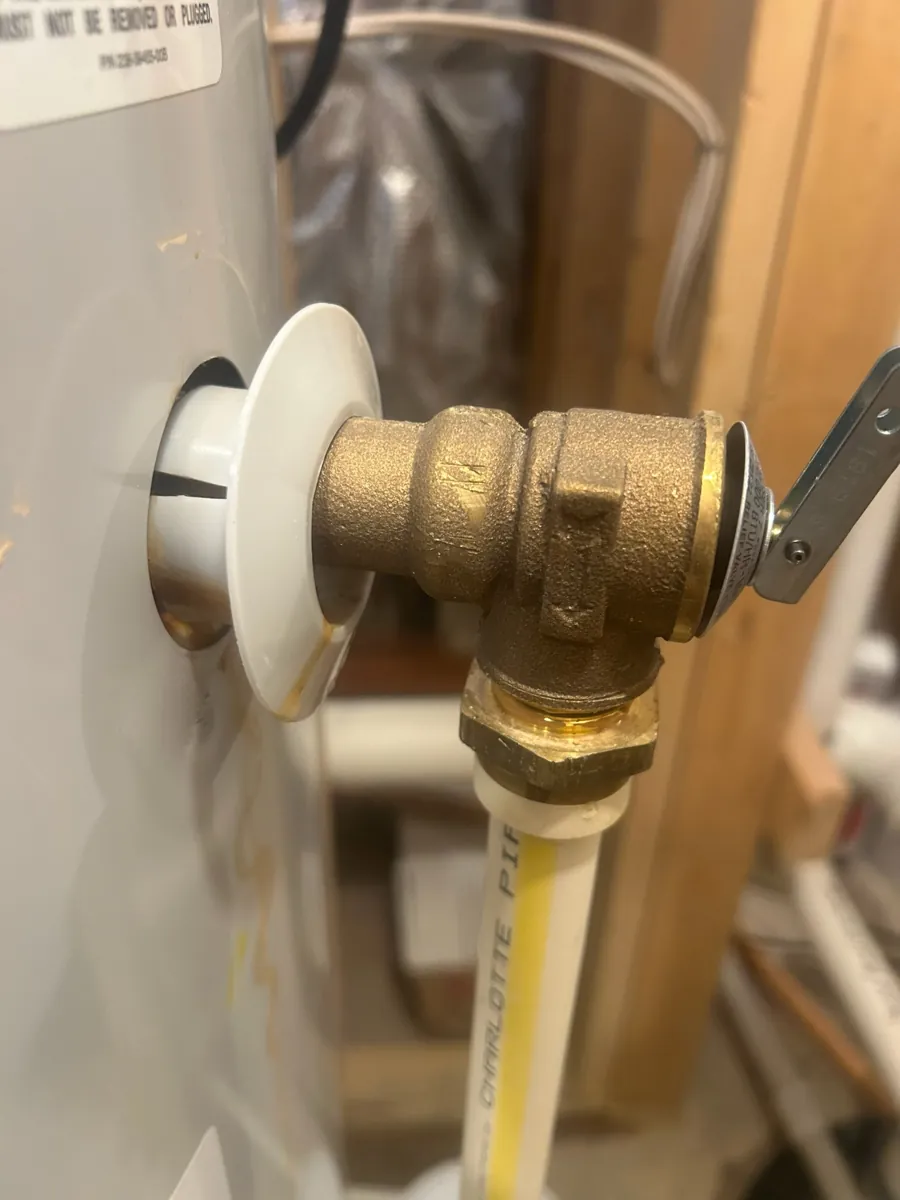 Water heater relief valve replacement · Clarksburg, MD · October 2026Clarksburg Gas Water Heater Leaking from the Relief Valve: Same-Day T&P Valve ReplacementAn 84-gallon gas water heater in Clarksburg started leaking, and the homeowner needed help the same day. Our technician came out that evening and replaced the temperature and pressure (T&P) relief valve.
Montgomery County specifics
- Clarksburg homes are served by WSSC Water. WSSC requires an annual test for lawn irrigation backflow assemblies, reported at spring start-up.
- WSSC Water says homes built from 2007 to 2009 were required to have testable double check valve assemblies on fire sprinkler systems, and that non-testable dual check valves must be rebuilt or replaced every five years.
- WSSC Water says multi-unit properties, including piggyback-style townhomes, generally must use registered plumbing firms rather than homeowner work.
Is this not for you?
Unhooking hoses, testing a sump pump and setting a water heater's temperature are homeowner jobs. Irrigation backflow testing in WSSC's area has to be done by a WSSC-licensed plumber who is a certified cross-connection technician. Fire sprinkler valve replacement is done by a certified WSSC Master Plumber, coordinated with a certified fire sprinkler contractor. If your home is under builder warranty, report covered problems to the builder first.
Frequently asked questions
Do I need to winterize frost-free outdoor faucets?
You need to disconnect the hose. A hose left on traps water in a frost-free faucet, and it can freeze and split inside the wall. If your home also has indoor shut-offs for the outdoor faucets, close them and drain the lines too.
How often does my fire sprinkler backflow valve need service?
It depends on the type. WSSC Water says testable assemblies need testing by a licensed cross-connection technician, while non-testable dual check valves must be rebuilt or replaced every five years.
When does my lawn irrigation backflow preventer need testing?
WSSC Water requires a field test every year, with results reported at spring start-up. It also has to be tested right after installation, repair or relocation.
My new home's water heater relief valve is dripping. Is that normal?
No. It can mean the valve is worn, or that pressure in the system is too high, often because the expansion tank has failed. Have it checked rather than capping or plugging it.
Why test a sump pump in the fall?
Fall rains and winter thaws are when it has to work. Pour a bucket of water in the pit and make sure it pumps out and shuts off. If it doesn't, replacing it before a storm is far cheaper than drying out a finished basement.